|
Michael Sigman
Forensic Trace Analysis
Recent AccomplishmentsJanuary, 2005: Mike Sigman and his co-investigators, Andrew Campiglia and Kevin Belfield, received a contract for a grant from DARPA. August, 2004: Alfons Schulte (PI), Otto Phanstiel, Mike Sigman, Suren Tatulian, and Sudipta Seal were awarded a grant from the National Science Foundation for the Acquisition of a Novel Raman and Fourier-Transform Infrared Microscope for Research and Education in Bio-materials, Nanoscience, and Forensics ($177,685).
Research
Our research focuses on the application of modern analytical techniques, primarily mass spectrometry, to solve problems in forensic trace analysis. Currently, we are examinding fire debris, explosives, fiber dye, accelerants, and trace analyses.
Fire debris analysis is an important area of forensic analysis that focuses on the detection and identification of ignitable liquids used to start fires in arson cases. Our recent studies have shed light on some of the fundamental limitations of current practices in fire debris analysis and have offered methods for potentially overcoming those limitations through sub-sample analysis. This outcome, coupled with the results from current and future studies, is likely to have a significant impact on fire debris analysis.
Another related, and important, research area is the analysis of explosives. The challenge in this field of research is to individualize the sample to the greatest extent possible through ultra-trace analysis of manufacturing and environmental impurities.
We also apply some of the techniques used for explosives analysis to forensic fiber discrimination. These improved fiber analysis methods are pushing back the frontiers of this traditional area of forensic trace analysis, which has recently come under increased criticism in criminal proceedings. Our studies of forensic fiber analysis have demonstrated the advantages of taking fiber dye analysis to the molecular level where higher discriminating power can be achieved.
New areas of research for our group involve the application of laser-induced breakdown spectroscopy (LIBS) to forensic trace analysis and the development of selective sampling materials. We are examining the discriminating power of LIBS in the analysis of various forms forensic trace evidence, with an initial focus on glass analysis.
 |
Fire, Arson, and Explosives
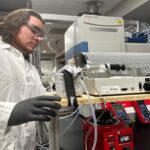
Our current efforts include understanding ignitable liquid vapors in fire debris samples, discoving new methods of explosives analysis, and the development of new laboratory and field test methodologies to improve forensic analytical capabilities and field safety.
|
 |
Physical Evidence: Fibers and Glass
Trace evidence often plays an important role in criminal cases.
|
Selected Publications
- Michael E. Sigman, Shelly Read, John T. Barbas, Ilia Ivanov, Edward W. Hagaman*, A. C. Buchanan, III Reza Dabestani, and Phillip Britt "Rapid Molecular Motion of Pyrene and Benzene Moieties Covalently Attached to Silica Surfaces" J. Phys. Chem. A 2003, 107, 3450-3456.
- Gapeev, A., Sigman, M. and Yinon, J*. "Liquid Chromatography/Mass Spectrometric Analysis of Explosives: RDX Adduct Ions," Rapid Comm Mass Spectrom., 2003, 17, 943-948.
- Min Huang, Jehuda Yinon, and Michael E. Sigman* "Forensic Identification of Dyes Extracted from Textile Fibers by Liquid Chromatography Mass Spectrometry (LC-MS)," J. Forensic Sci. 2004, 49(2), 238-249.
- R. A. Gardner, J.-G. Delcros, F. Konate, F. Breitbeil III, B. Martin, M. Sigman, M. Huang, and O. Phanstiel IV* "N1-Substituent Effects in the Selective Delivery of Polyamine-Conjugates into Cells Containing Active Polyamine Transporters," J. Med. Chem. 2004, in press.
- M. R. Williams, D. Fernandes, C. Bridge, D. Dorrien, S. Elliot and M. Sigman* "Adsorption Saturation and Chromatographic Distortion Effects on Passive Headspace Sampling with Activated Charcoal in Fire Debris Analysis," J. Forensic Sci. 2005, in press.
- M. Huang, R. Russo, B. G. Fookes and M. E. Sigman* "Analysis of Fiber Dyes by Liquid Chromatography Mass Spectrometry (LC-MS) with Electrospray Ionization: Discriminating Between Dyes with Indistinguishable UV-Visible Absorption Spectra," J. Forensic Sci 2005, in press.
Graduate Students
Students working in this research group gain fundamental knowledge in a variety of modern analytical areas coupled with a very real connection to the applied endpoints of their research. It is this broader understanding that produces a graduate who is well-grounded in the fundamentals and has a satisfaction of knowing that their research is having a positive impact on the field of forensic science. The variety of projects underway in the laboratory gives each student a broader overall picture of challenges and research opportunities in forensic science. Graduate and undergraduate students work together to provide a complete and productive educational experience. Each project is undertaken with the educational goal of providing the student with opportunities to communicate the results of their work through research publications and scientific presentations. A minimum of one peer-reviewed research publication is expected from each graduate student.
|